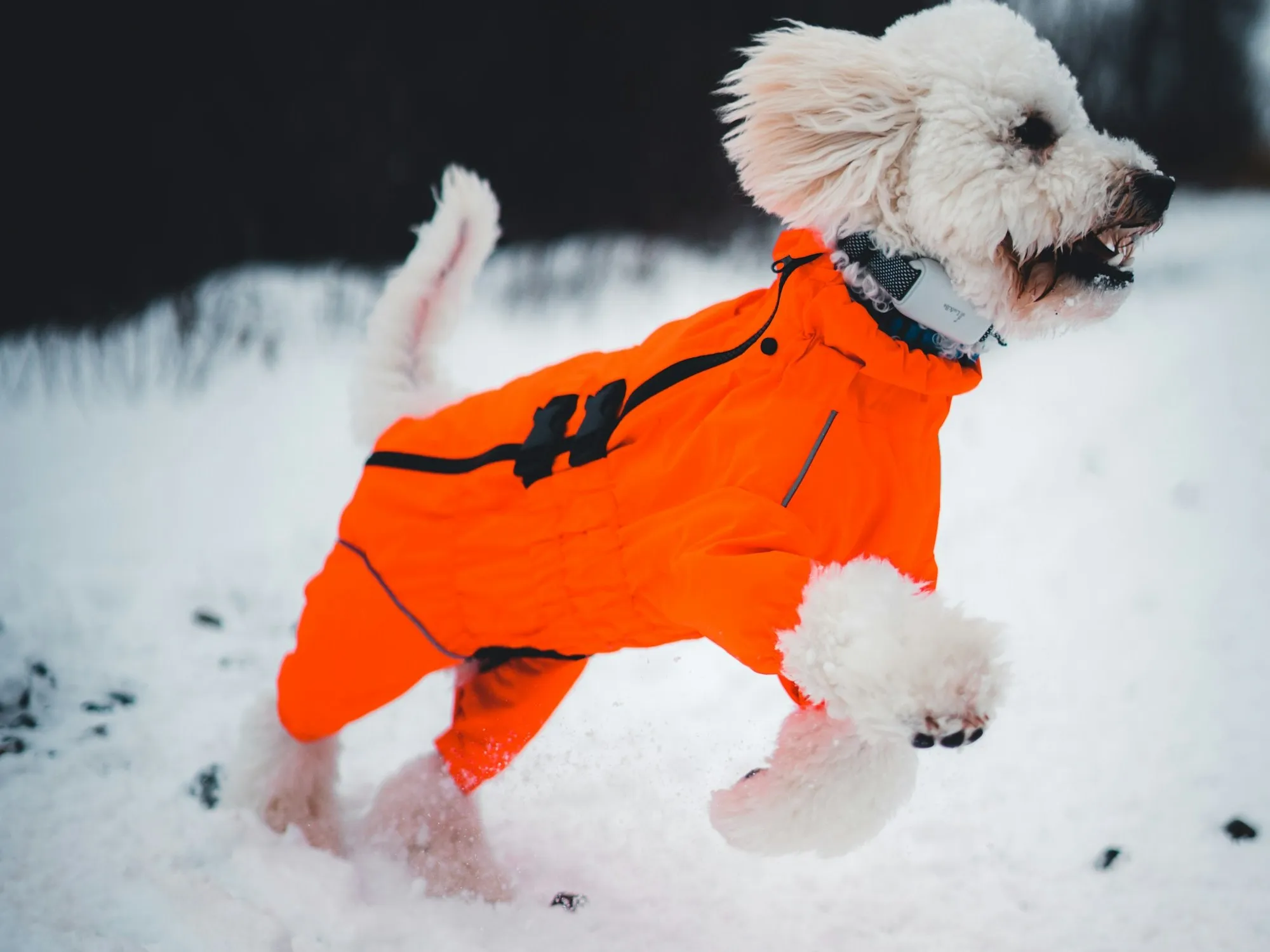
A dog that comes along for the snow day is a different gear problem than a dog being dressed up for a city sidewalk. The snow-day dog is out in it: deep cold, wet snow, salted trails, low winter light on the walk back to the car. What that dog needs from a coat is warmth that survives moisture, coverage where it loses heat, and enough visibility that you and everyone else can see it against the white. Style is beside the point.
Not every dog needs a coat at all. A husky or a malamute is wearing one already. But short-haired, single-coated, small, old, or lean dogs lose heat fast, and for them a good winter coat is the difference between a happy hour in the snow and a miserable, shivering ten minutes. The six picks below are built for genuine winter use, drawn only from brands that make real cold-weather dog gear, and sorted by the job you need the coat to do: five warm jackets and coats plus one dedicated visibility vest.
- How these dog jackets were chosen
- The six dog jackets at a glance
- Does your dog need a coat?
- RUFFWEAR Furness
- Canada Pooch Everest Explorer
- Hurtta Extreme Warmer III ECO
- WeatherBeeta ComFiTec Parka
- Voyagers K9 Made-to-Measure Coat
- RUFFWEAR Lumenglow Hi-Vis Vest
- How to choose and fit a dog coat
- Frequently asked questions
How these dog jackets were chosen
Selection started with brands that make genuine cold-weather dog gear rather than fashion-first pet apparel, so the list is limited to Hurtta, RUFFWEAR, Canada Pooch, Voyagers K9 Apparel, and WeatherBeeta. Each pick is a current model, and the specifications and US prices were checked against each brand’s product page and major retailers in June 2026. Prices and stock move, especially off-season, so treat the figures as a snapshot.
This guide is spec-based, not field-tested. Recommendations come from each garment’s published construction, insulation, and coverage, matched to a winter use case. Most dog coats do not publish standardized, independently comparable temperature ratings; a few brands publish their own guidance, like Hurtta’s thermal range for the Extreme Warmer III ECO, but real-world warmth still depends on the individual dog and the day, from its coat and size to its health, its activity level, and the wind, moisture, and time it spends outside.
The six dog jackets at a glance
| Jacket | Award | Warmth | Weather | Coverage | US price |
|---|---|---|---|---|---|
| RUFFWEAR Furness | Best Overall | High-loft 250g recycled fill | DWR, sheds snow | Neck, back, belly, hips, sleeves | ~$130 |
| Canada Pooch Everest Explorer | Best Value | Faux-down + fleece lining | Water-resistant shell | Back and chest | ~$50 to $80 |
| Hurtta Extreme Warmer III ECO | Best for Extreme Cold | Ball-fiber + heat-reflective lining | Waterproof, taped seams | Full back and belly wrap | ~$100 to $135 |
| WeatherBeeta ComFiTec Parka | Best for Snow and Wet | 220g polyfill | Fully waterproof 1200D shell | Full chest and belly | ~$66 |
| Voyagers K9 Made-to-Measure | Best for Hard-to-Fit Dogs | Polartec fleece lining | Water-resistant Taslan, DWR | Custom, back and chest | from ~$170 |
| RUFFWEAR Lumenglow Vest | Best Visibility | None (shell vest) | Water-repellent | Sleeveless vest | ~$50 |
Prices verified June 2026 and rounded; all are sized by the dog’s measurements (see the fit section). Warmth is described by construction, not a temperature rating.
Does your dog need a coat?
Before buying anything, it is worth knowing whether your dog needs a coat and which kind. The dogs that benefit most are short-haired and single-coated breeds (think pointers, whippets, boxers), small breeds that lose heat fast relative to their size, lean breeds with little insulating fat, puppies, and senior dogs whose temperature regulation has slipped. Double-coated northern breeds usually do not need one and can overheat in a heavy coat.
Activity matters too. A dog running hard generates heat and may want less coat than one standing around while you dig out the car or fish through the ice. If your dog shivers, lifts its paws, tucks its tail, slows down, or wants to turn back, end the outing or warm the dog up. A coat may help next time, but lifted paws can also mean ice, salt, or paw pain, so check the feet too. The rest of this guide assumes your dog is one that benefits from a coat.
RUFFWEAR Furness
Best Overall
The Furness is RUFFWEAR’s warmest jacket at around $130, and the coverage is what sets it apart. High-loft 250-gram recycled insulation wraps head to tail, including articulated sleeves over the front legs and panels down the hips and belly, which is where a dog loses heat. Neck and belly cinches dial the fit, and a back leash portal works over most harnesses. The shell is treated to shed snow rather than soak it up, though it is not a fully waterproof layer. For a dog that is out in real cold for real stretches, this is the coat that covers the most of it without a single glaring compromise. Furness availability is seasonal, so if your size is out of stock at write time, check RUFFWEAR for restock dates.
Strengths
- The most body coverage here, including legs and belly
- Warm high-loft insulation
- Adjustable fit with a harness-compatible leash portal
Tradeoffs
- Shell sheds snow but is not fully waterproof
- Sleeved fit takes more getting used to than a simple wrap
- Premium price for the category
- Insulation
- High-loft 250 g recycled
- Coverage
- Neck, back, belly, hips, sleeves
- Weather
- DWR, sheds snow
- Fit
- Adjustable, harness portal
- Price
- ~$130
Best for the dog that joins you for long, cold days and needs maximum coverage. Skip it for a thick double-coated breed that runs warm already.
Canada Pooch Everest Explorer
Best Value
The Everest Explorer delivers most of what a snow-day dog needs at the lowest price among the warm picks here. It pairs faux-down insulation with a soft fleece lining and adds a removable hood with faux-fur trim, on a water-resistant nylon shell, with a slot for a leash or harness. Coverage is back-and-chest rather than the full belly wrap of the pricier options, so it is a notch less complete in deep cold, but for everyday winter walks and milder snow days it covers the basics for well under $80. A reflective colorway adds some low-light visibility.
Strengths
- Warm faux-down and fleece for the price
- Removable hood and harness slot
- Reflective colorway option
Tradeoffs
- Less belly coverage than the premium picks
- Water-resistant, not waterproof
- Numbered sizing runs less precise than custom
- Insulation
- Faux-down + fleece
- Coverage
- Back and chest
- Weather
- Water-resistant
- Hood
- Removable, faux-fur trim
- Price
- ~$50 to $80
Best for everyday winter walks on a budget. Skip it if your dog is out in deep cold or heavy wet for hours.
Hurtta Extreme Warmer III ECO
Best for Extreme Cold
When it is brutal out, the Hurtta Extreme Warmer III ECO (around $100 to $135) is built for it. It is the only pick here that combines down-like ball-fiber insulation with a heat-reflective lining that bounces the dog’s own warmth back, and it wraps that around a fully waterproof Houndtex shell with taped seams (rated above a 10,000 mm water column, with a fluorocarbon-free water-repellent finish). The result is warmth that holds up in wet cold rather than collapsing the moment snow melts into it. Multiple adjustment points and low-rider and large-neck variants help it fit a range of body shapes. Hurtta lists the Extreme Warmer III ECO in a thermal range of about +20°F to -20°F; treat that as brand guidance, not a guarantee, because there is no universal dog-coat temperature-rating standard. It is a serious winter and slush coat, not a dedicated raincoat, so reach for a true rain shell in warmer heavy rain.
Strengths
- Heat-reflective lining plus insulation, warmest construction here
- Waterproof with taped seams
- Multiple fit adjustments and body-shape variants
Tradeoffs
- More coat than a mild-climate dog needs
- Pricier than the value picks
- Brand thermal range is guidance, not a tested standard
- Insulation
- Ball-fiber
- Coverage
- Full back and belly wrap
- Weather
- Waterproof, taped seams (10,000 mm)
- Thermal range
- +20°F to -20°F (brand)
- Price
- ~$100 to $135
Best for dogs out in severe, wet cold. Skip it if your winters are mild or your dog runs hot.
WeatherBeeta ComFiTec Parka
Best for Snow and Wet
WeatherBeeta comes from the horse-blanket world, and the toughness shows. The ComFiTec Parka uses a 100% waterproof, breathable 1200-denier triple-weave shell, the kind of fabric built to live outdoors and shrug off abrasion, over 220 grams of polyfill insulation and a polyester lining. It wraps the full chest and belly, closes with touch-tape, and has elasticized leg straps to keep it put. For the dog that is out in wet snow, slush, and sleet rather than dry powder, the combination of a waterproof, durable shell and real insulation at around $66 list, often discounted, is hard to beat.
Strengths
- Fully waterproof and very durable 1200D shell
- Real insulation with full belly coverage
- Strong value for a waterproof insulated coat
Tradeoffs
- Blanket-like fit, less athletic than Ruffwear or Hurtta
- Bulkier than a lightweight active coat
- A horse-brand crossover, so US sizing varies by retailer
- Insulation
- 220 g polyfill
- Coverage
- Full chest and belly
- Weather
- Fully waterproof
- Shell
- 1200D triple-weave
- Price
- ~$66 list
Best for wet snow, slush, and sleet. Skip it if you want a trim, active-fit coat for a running dog.
Voyagers K9 Made-to-Measure Coat
Best for Hard-to-Fit Dogs
Voyagers K9 is the hard-to-fit pick, not just the small-dog pick. Sizing is the hardest part of buying a coat for an oddly proportioned dog, and Voyagers K9 Apparel solves it by cutting the coat to your dog’s exact measurements, starting around the low $170s and rising with size. The made-to-measure winter coat lines a water-resistant Taslan nylon shell with quick-dry Polartec fleece and an integrated hood, with reflective piping and custom harness openings on request. For dachshunds, small terriers, deep-chested or short-legged dogs, and anything the numbered sizing charts never quite fit, a custom coat that conforms to the body is worth the higher price and the wait. One caveat: Voyagers’ made-to-measure program is on hiatus until February as of this writing, so check the current ordering status before counting on it as an immediate buy.
Strengths
- Custom-cut fit for small and hard-to-fit dogs
- Quick-dry Polartec fleece lining and hood
- Reflective piping and optional custom harness openings
Tradeoffs
- Most expensive option, and made to order means a wait
- Water-resistant, not fully waterproof
- Fleece-lined warmth rather than high-loft insulation
- Insulation
- Polartec fleece lining
- Coverage
- Custom, back and chest
- Weather
- Water-resistant (Taslan, DWR)
- Sizing
- Made-to-measure (seasonal hiatus)
- Price
- from ~$170
Best for hard-to-fit dogs the standard sizes fail. Skip it if an off-the-shelf size fits well, you want it sooner, or the made-to-measure program is still on hiatus.
RUFFWEAR Lumenglow Hi-Vis Vest
Best Visibility
Winter light is short and flat, and a dog can vanish against snow faster than you would expect, which is what the Lumenglow is for. It is a high-contrast, blaze-colored shell vest, around $50, with reflective side panels designed to be seen in daylight and to light up under headlights or a headlamp at night, plus a loop for a clip-on safety light. The honest caveat is that it is a visibility layer, not a warm coat: it is a single-layer vest with no insulation. Think of it as the piece you add over a base coat, or wear on milder days, when being seen matters most, such as low-light walks, hunting season, or roadside trails. The warm picks above all carry some reflective trim, but none is purpose-built for visibility the way this is. Lumenglow availability is also seasonal; if it is out of stock, pair any reflective winter coat with a clip-on dog safety light.
Strengths
- Purpose-built high-visibility, day and night
- Light loop for a clip-on safety light
- Layers over a warmer coat
Tradeoffs
- No insulation; not a cold-weather coat on its own
- Adds a second layer to manage
- Best paired with a warm coat in real cold
- Insulation
- None (shell vest)
- Coverage
- Sleeveless vest
- Weather
- Water-repellent
- Visibility
- Blaze + reflective panels
- Price
- ~$50
Best when being seen is the priority, over a warm layer or on milder days. Skip it as a standalone coat in serious cold.
How to choose and fit a dog coat
How to measure your dog
Most coats are sized by back length, so measure that first: along the spine from the base of the neck, where the collar sits, to the base of the tail. Then measure chest girth at the widest point just behind the front legs, and neck circumference. Measure the dog standing and relaxed. If you land between sizes, size up for a fluffy double-coated dog and down for a lean short-haired one. A coat that is too long catches on things and rides up; one that is too short leaves the belly and chest cold.
Closures and coverage
Look at how the coat fastens and how much it covers. Touch-tape (hook-and-loop) is easy to put on a wriggly dog but collects fur and ice; buckles and clips hold more securely; a step-in or onesie style covers more but is fussier to get on. For warmth, belly and chest coverage matters as much as back coverage, because that is where a dog radiates heat. A leash portal or harness opening lets you keep the harness under the coat.
When a dog dislikes the coat
A dog that fights the coat will not wear it, so introduce it gradually. Let the dog investigate the coat and reward calm interest, then drape it on for a few seconds with treats, then progress to fastening it and to short indoor wear before heading out. Keep sessions short and positive and pair the coat with something the dog loves, like a walk. Most dogs come around within a week or two once the coat predicts good things.
Cold-weather warning signs
Know what too-cold looks like. Early signs are shivering, whining, slowing down, lifting paws, and wanting to head home. More serious cold shows as lethargy, weakness, a slow or weak pulse, and shallow breathing, which point toward hypothermia. If you see those, get the dog warm and dry and call a vet rather than pushing on. A coat reduces the risk but does not remove it, and small, young, old, and lean dogs hit the wall sooner.
Paws and visibility
Two things round out winter dog gear. Paws take a beating from ice balls, road salt, and frozen ground, so consider booties (the most complete protection if your dog tolerates them) or a paw balm, and rinse the paws after salted walks so the dog does not lick chemicals off. And because winter light is poor, add visibility with a reflective coat, a high-vis vest, or a clip-on light, especially for dawn, dusk, and roadside walks.
Frequently asked questions
Does my dog need a winter coat?
Some dogs do, some do not. Short-haired and single-coated breeds, small dogs, puppies, seniors, and lean breeds with little body fat lose heat fast and benefit from a coat in real cold. Thick double-coated breeds like huskies and malamutes are built for it and usually do not need one. If your dog shivers, lifts its paws, or wants to turn back early, warm it up and check the feet for ice or salt; a coat may help on future cold outings.
How do I measure my dog for a jacket?
Measure three things with a soft tape: back length from the base of the neck (where the collar sits) to the base of the tail, chest girth at the widest point just behind the front legs, and neck circumference. Back length is the primary number most brands size by. Measure the dog standing, and if you are between sizes, size up for a double-coated dog and down for a lean short-haired one.
What if my dog hates wearing a coat?
Introduce it gradually rather than forcing it. Let the dog sniff the coat, reward calm interest, then drape it on for a few seconds with treats, building up to clipping it closed and then to short indoor wear before going outside. Keep early sessions short and positive. Most dogs accept a coat within a week or two once they associate it with treats and going out.
How can I tell if my dog is getting too cold?
Watch for shivering, whining or anxiousness, slowing down, lifting or favoring paws, and seeking shelter or wanting to head home. More serious cold and early hypothermia show as lethargy, weakness, a slowed or weak pulse, and shallow breathing. If you see those signs, get the dog warm and dry and contact a vet. Do not wait it out.
Do dogs need paw protection in winter too?
Often, yes. Ice balls between the pads, road salt and de-icer chemicals, and frozen ground all irritate paws. Dog booties solve it most completely if your dog tolerates them; a paw balm or wax adds a protective layer and is easier to get a dog to accept. Either way, rinse and dry the paws after a salty walk so the dog does not lick the chemicals off.
The short version
For a snow-day dog that needs one coat to do everything, the RUFFWEAR Furness covers the most of the dog and stays warm through a long day. If the budget is tighter, the Canada Pooch Everest Explorer covers the basics for well under $80.
From there, match the coat to the conditions: the Hurtta Extreme Warmer III ECO for severe wet cold, the WeatherBeeta Parka for slush and sleet, the Voyagers K9 made-to-measure coat for hard-to-fit dogs, and the Lumenglow vest when visibility matters most. Whatever you choose, fit it properly and watch the dog for cold. And when you are sorting your own kit, do not forget the best winter coats for extreme cold; the rest of the Winter Outerwear section covers the human side of the snow day.
Specifications and prices in this guide were verified against current brand information and major US retailers in June 2026. Prices, models, and stock change; confirm the current details on the brand’s product page before buying. If you find an error in this guide, please email corrections@slopehound.com.