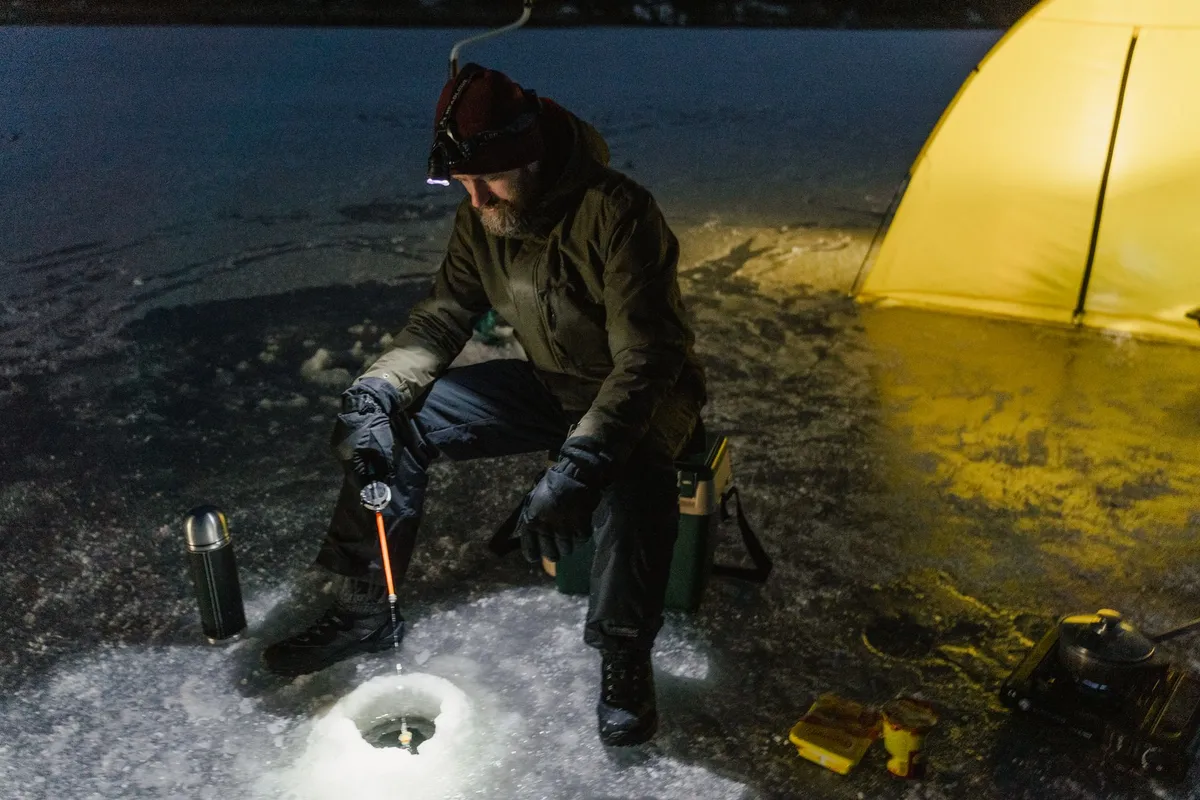
Before buying a light for ice fishing, decide what you need it to do. Seeing a knot inside a shelter, finding your equipment after dark, and experimenting with an underwater light are three different jobs. A good headlamp handles the first two wherever you move. A submersible adds equipment, battery demand, and a rules question to settle before you leave home.
Start with light you can depend on for the trip out and back. Then decide whether the underwater experiment earns a place in the sled.
What an underwater light can tell you
Anglers use submersible lights in the hope of drawing fish or their prey toward a fishing spot. That is a reason to experiment where permitted, not a promise of more catches. A brighter patch of water does not establish that fish are present, feeding, or willing to take your bait.
The useful comparison is what happens at your spot with and without the light. Keep track of the time, depth, water clarity, and fish activity. If you change the lure, depth, and light together, you will have little idea which change helped. Avoid buying a selection of colors before you have learned anything from the first light.
Setting up a submersible light
Try the equipment at home first. Confirm that the light, power supply, and connectors are compatible, that the cable reaches the intended depth, and that you know how to support and retrieve the light. A waterproof lamp does not necessarily make its power connection waterproof.
At the fishing spot, route the cable away from feet, sharp edges, and moving equipment. Keep it separate from the fishing line so a fish or a lifted lure does not snag it. Follow the light’s limits for immersion depth and operating time.
Begin with a placement you can retrieve easily, then change one variable at a time. Note the depth and position instead of treating a fixed number of feet below the ice as a recipe. If you cannot distinguish a useful response, reconsider whether the extra equipment is helping. There is no obligation to keep running it simply because you brought it.
Choose the power supply with the light
The shopping question is not just how bright the light gets. Check its power draw, required voltage, cable length, operating temperature, and immersion limits. Confirm what is included: a low lamp price can leave a battery, charger, and suitable connections still to buy.
A simple battery calculation
For a hypothetical 10-watt light running for five hours, the light alone needs 50 watt-hours: 10 watts multiplied by five hours. A battery labeled 12 volts and 10 amp-hours has a nominal capacity of 120 watt-hours. That does not mean all 120 will be available to your setup; usable capacity, operating conditions, and losses matter.
Add the demand of any other devices sharing the supply and allow a reserve. Compare figures at the same voltage rather than treating an amp-hour label by itself as a runtime. Follow the battery’s operating and charging limits, and use connections intended for the equipment and environment. Keep a separate headlamp available if the shared supply runs down.
Make the shelter easier to work in
Place a shelter light so your hands do not cast a shadow over the knot or tackle you are working on. Aim it away from other people’s eyes and try a lower brightness setting before adding another lamp. More light can be less helpful than better placement.
Secure the lamp using the shelter’s suitable attachment points. Route cables where they cannot catch a boot or fishing rod, and keep connections clear of slush. Try opening bags, reaching the door, and tending a line with the setup in place. An arrangement that works while everyone sits still may become awkward as soon as someone stands up.
Keep your personal light separate
A headlamp stays with you when you leave the shelter. Check the controls with gloves on, the fit over your hat, and whether you can see both close work and your immediate route. The brightest setting is only useful if its runtime suits the job.
Carry a backup light or compatible spare batteries and protect them as the manufacturer directs. Test the setup before leaving shore. A phone light can be awkward to hold while handling equipment, and using it continuously draws on the same device you may need for communication.
Would a camera answer a different question?
A camera is an observation tool. It may help you see what is below the hole and how fish respond to a presentation, when visibility allows. A light changes the illumination. Buying both at once makes it harder to work out which tool you needed.
If your question is whether fish are inspecting and rejecting your bait, observation may be more useful than another light. If you mostly need to see your hands inside the shelter, neither device solves that problem as directly as a well-positioned lamp. Check the rules for the exact equipment you intend to use.
Start with the fish and location
Choose a location and presentation for the fish you are targeting before adding a light. A general claim that a species responds to light does not establish where it will be in your lake that evening. Ask local fisheries staff or an experienced local guide about seasonal behavior and permitted methods.
Keep a brief note of fish activity alongside your lighting changes. A session with no response is still useful information if it stops you buying a larger light to solve a location problem.
Problems worth solving before dark
| Problem | Useful check |
|---|---|
| Light fades before the trip ends | Calculate demand for every device sharing the battery |
| Cable tangles with the fishing line | Separate the cable route and retrieval point |
| Shelter looks bright but knots are hard to see | Move the lamp to reduce shadows over your hands |
| One failed power supply leaves everyone in the dark | Carry independent personal lighting |
| You cannot tell whether the submersible helped | Change one setting or position at a time |
Check whether attraction lights are permitted
Permission to use a lamp in your shelter does not establish permission to attract fish with one underwater. For example, the Minnesota DNR identifies artificial light used as an attractant as prohibited unless it is expressly part of a lure. Do not transfer that rule, or an exception to it, to another state.
Read the current fishing regulations for the specific water and method. Look for artificial lights, attractants, lighted lures, cameras, and any shelter requirements. If the wording does not clearly address your setup, ask the responsible agency before using it. A light being available for sale does not establish where it is legal to use.
Lighting does not establish safe ice
A headlamp helps you see the surface; it cannot tell you the ice’s strength. Conditions vary across a lake, and a measurement near shore does not establish conditions farther out. Follow current local guidance and reassess as you travel.
The Minnesota DNR’s guidelines say to stay off ice under four inches and list four inches for activities on foot. Those figures apply to new, clear ice. They are not a guarantee, and other ice types and local conditions require further caution. Traction devices help with footing but do not strengthen the ice.
If someone falls through, call 911 immediately. Do not run to the hole. The DNR’s rescue guidance describes reaching from shore if you can do so safely, or throwing a rope or something that floats. Avoid becoming a second victim.
Frequently asked questions
Do lights work for ice fishing?
A headlamp and shelter light help you handle equipment after dark. An underwater attraction light is a separate experiment with no guaranteed catch benefit. First confirm that it is permitted, then observe whether it makes a useful difference at your spot.
What color light is best for ice fishing?
There is no single color recommendation that settles every lake and situation. Before buying several colors, try one permitted setup and track the response while keeping other parts of your presentation consistent.
How deep should the light go, and how far from the hole?
Stay within the equipment’s immersion limits and separate the cable from your fishing line. Start with an easily retrievable placement and adjust one variable at a time. A fixed depth or distance cannot guarantee fish activity.
Is it legal to use lights for ice fishing?
Check the current rules for your state, water, and fishing method. A shelter lamp, an underwater attraction light, and a lighted lure may be treated differently. Ask the responsible agency if your exact setup is unclear.
Do I need an underwater camera as well as a light?
No. A camera helps you observe what is below the hole when visibility permits; a light changes the illumination. Choose equipment for the question you need to answer rather than buying both automatically.
Pack for the return trip too
Test the lights, plan the battery demand, and keep personal lighting independent of the main supply. Set up cables while you can see them clearly, and keep the equipment you need for leaving within reach. If a submersible adds more complication than useful information, leave it out next time.
For footing on the approach, compare the ice cleat options with your actual winter boots. Fit and careful movement still matter once the lights are on.