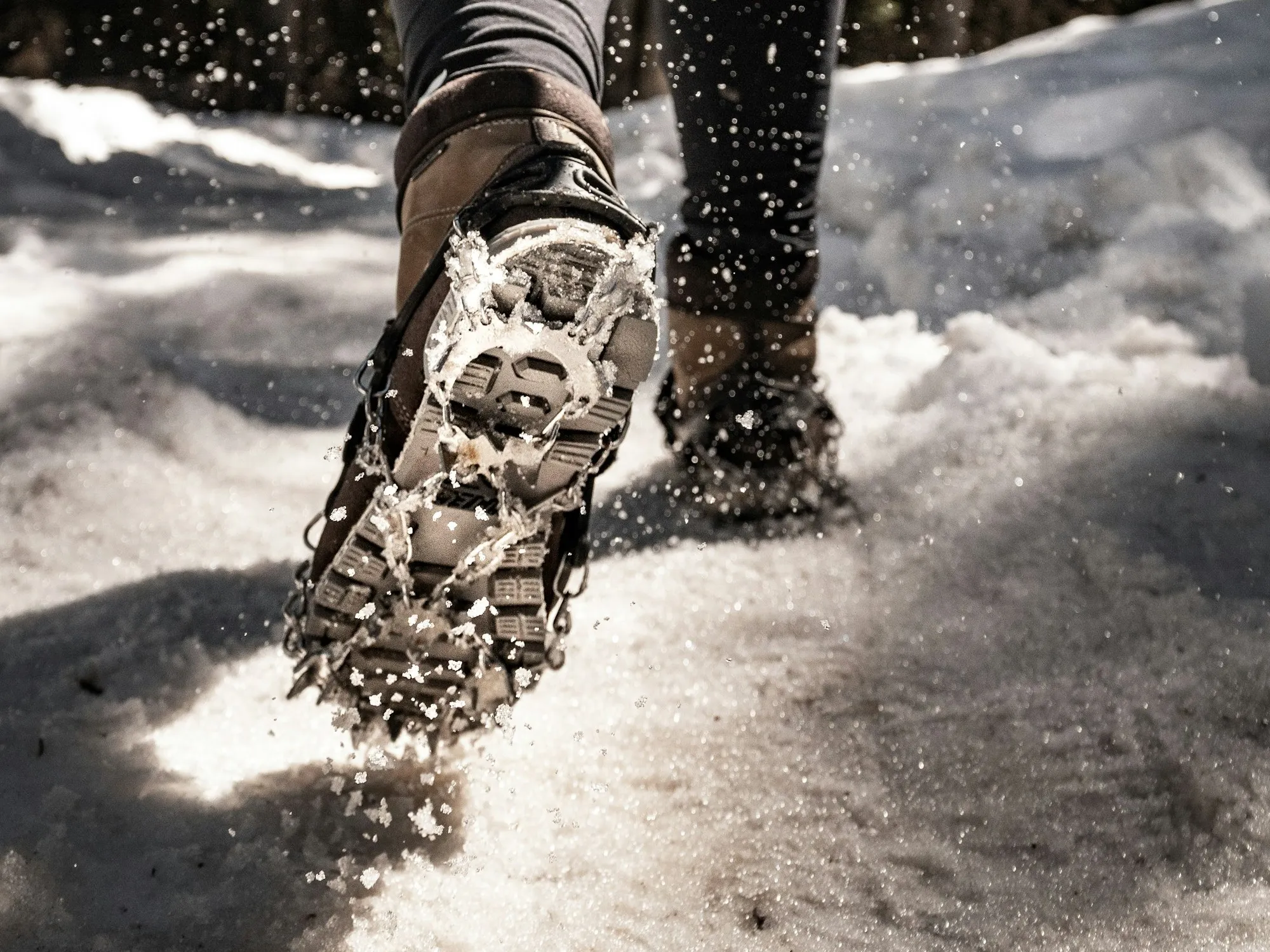
Walking out onto a frozen lake is the part of ice fishing nobody plans for and everybody does anyway. Bare ice gives a boot sole almost nothing to hold, and a hard sheet of it is an unforgiving thing to land on. Most anglers already know this, so the point here is not to dwell on the risk, it is to put something between your boots and the ice that grips. That is what an ice cleat does: a harness of metal spikes, carbide studs, or steel coils that stretches over your existing boots and turns a slick walk into a stable one.
The good news is that the gear is cheap and effective, and you do not need much of it. A flat lake does not call for mountaineering crampons; it calls for a walking traction device that bites hard ice and stays comfortable over the distances you cover, from the truck to the spot and back. The six picks below cover that range, from a $30 pair of coils to a replaceable-cleat workhorse, sorted by how you fish rather than by price alone.
Ice cleats solve one problem: slipping. They do not tell you whether the ice can support your weight. Before walking onto any frozen lake, check current local ice reports, test thickness as you go, and remember that ice thickness can vary across the same lake. The full ice-safety treatment, including thickness guidelines and what to carry, is in the guide to using lights in ice fishing. It’s the same discipline backcountry skiers bring to snow: read the conditions before committing to terrain.
How these cleats were chosen
Selection started with traction devices built for walking on flat, hard ice, which is what ice fishing involves, rather than technical climbing hardware. Each pick is a current, in-production model, and the specs, weights, and US prices were checked against each maker’s current product page and major retailers in June 2026. Prices move, so treat the figures here as a snapshot.
The awards sort by use case, not by a single best-to-worst ranking. The right cleat for a short walk across glare ice to a shanty is not the same as the one you want for a mile of lake walking with an auger over your shoulder. Each pick notes who it suits.
This guide is spec-based, not field-tested. Recommendations come from current manufacturer specs, product design, and the use-case logic that matches each device to an ice-fishing scenario.
The six cleats at a glance
| Cleat | Award | Grip type | Weight (pair) | Packs down | US price |
|---|---|---|---|---|---|
| Kahtoola MICROspikes | Best Overall | 12 stainless spikes, 0.41 in | 10.5 to 14.9 oz | Yes, with pouch | ~$84 |
| Yaktrax Pro | Best Value | Steel coils | ~4 oz | Very small | ~$30 |
| Hillsound Trail Crampon | Best Aggressive Grip | 11 carbon-steel spikes, 2/3 in | 16.3 oz | Bulky | ~$85 |
| STABILicers Maxx 2 | Best Studded Rubber | 15 replaceable steel cleats, TPE binding | Heaviest here | Bulky | ~$70 |
| Kahtoola NANOspikes | Best Lightweight | 10 carbide spikes, 0.21 in | 6.4 to 8.4 oz | Very small | ~$64 |
| Kahtoola EXOspikes | Best for Long Distance | 12 carbide spikes, 0.29 in | 6.6 to 8.1 oz | Small | ~$74 |
Prices verified June 2026 and rounded; all six stretch on over the winter boots you already wear. Weights are the manufacturer ranges across sizes.
Why traction matters on the ice
Bare lake ice, especially the wet or refrozen kind that looks polished, offers a smooth boot sole almost no friction. The fix is mechanical: short metal points or coils that press into the surface and hold. That is the whole job of an ice cleat, and it is why the grip type matters more than any other single feature.
Three grip styles cover the field. Spikes are short metal teeth, usually a third to two-thirds of an inch, hanging from a chain or plate under the foot; they are designed to bite hardest into hard, bare ice. Studs are shorter carbide points set into a plate, lower-profile and more comfortable for long walks while still gripping ice. Coils are wound steel cable across the sole, which grabs packed snow and mixed surfaces nicely but bites less on smooth glare ice than points do. For most ice fishing, a spike or stud model is the safer match; coils are the budget and packed-snow choice.
Kahtoola MICROspikes
Best Overall
The MICROspikes are the traction device most other traction devices get compared to, and this design earns the award. Twelve heat-treated stainless-steel spikes per foot hang from welded chains under a stretchy elastomer harness that pulls on over a winter boot in seconds and stays put. Based on the spike geometry and pattern, they are built to engage hard lake ice rather than skate across it, the stainless-steel chain construction is designed for durability across seasons, and they pack into a small pouch when you are off the ice. At around $84 they are not the cheapest option, but they are the pick with the fewest compromises for bare lake ice.
Strengths
- Aggressive spike pattern designed for hard ice
- Durable stainless chain construction
- Easy on and off, packs small
Tradeoffs
- Pricier than coil-style options
- More spike than you need for snow-covered ice
- Chains can collect snow in deep powder
- Grip type
- Stainless spikes
- Spikes
- 12 per foot, 0.41 in
- Weight
- 10.5 to 14.9 oz
- Packs down
- Yes, with pouch
- Price
- ~$84
Best for the angler who wants one pair that handles any ice without thinking about it. Skip it only if your budget is tight or your walking is mostly over packed snow.
Yaktrax Pro
Best Value
The Yaktrax Pro is the entry point to real traction, and for the money it does a lot. Instead of spikes it uses steel coils wound across the sole, secured with a strap over the foot, and the whole thing weighs almost nothing and packs into a jacket pocket. On packed snow and mixed snow-and-ice the coils are designed to grip well and walk comfortably. The honest limit is bare glare ice, where coils hold less than spikes or studs do, so this is the pick for anglers whose route is mostly snow-covered or who want a cheap pair to keep in the truck. At around $30 it is the easiest pair on this list to justify buying.
Strengths
- Inexpensive and very light
- Comfortable, natural walking feel
- Strap adds security over the foot
Tradeoffs
- Coils bite less than spikes on bare glare ice
- Coils can wear or deform over hard seasons
- Less reassuring on the slickest surfaces
- Grip type
- Steel coils
- Attachment
- Strap-secured
- Weight
- About 4 oz
- Packs down
- Very small
- Price
- ~$30
Best as an affordable first pair or a snow-and-ice all-rounder. Skip it if you regularly cross bare, polished ice, where points grip better.
Hillsound Trail Crampon
Best Aggressive Grip
When the ice is treacherous, the Hillsound Trail Crampon brings the longest spikes in this group, and at around $85 it is priced like the MICROspikes. Eleven heat-treated carbon-steel points around two-thirds of an inch sit on a semi-rigid plate with a hinged front, and the length is designed to dig into glare ice and crusted, uneven surfaces that shorter spikes skate over. A ratcheting strap locks the harness down. This is more grip than a flat lake usually demands, which is the point: it is the pick for steep or rough approaches down to the water, or for the kind of hard, sloping shoreline ice that makes a fall likely.
Strengths
- Longest, most aggressive spikes here
- Secure ratchet strap and stable plate
- Built for glare ice and rough approaches
Tradeoffs
- Heavier and bulkier to carry
- More spike than flat-lake walking needs
- Longer points feel clumsy on bare ground
- Grip type
- Carbon-steel spikes
- Spikes
- 11 per foot, 2/3 in
- Weight
- 16.3 oz
- Packs down
- Bulky
- Price
- ~$85
Best for sketchy, sloping, or glare-ice approaches. Skip it if your walking is flat and you would rather carry something lighter.
STABILicers Maxx 2
Best Studded Rubber
The STABILicers Maxx 2 takes a different approach for around $70: a full thermoplastic elastomer (TPE) overshoe studded with 15 replaceable heat-treated steel cleats, held on with hook-and-loop straps from heel to toe. The full TPE sole spreads underfoot for a planted, stable stance, and the steel cleats are designed to grip hard ice. The real argument for it is longevity. When a cleat wears down you replace that cleat rather than the whole device, so a Maxx 2 can outlast several disposable pairs, which is why it is popular with people who work on ice all winter. The trade is weight and bulk.
Strengths
- 15 replaceable cleats mean a very long service life
- Planted, stable feel from the full TPE sole
- Built for heavy, all-season use
Tradeoffs
- Heaviest and bulkiest pick here
- More device than a casual angler needs
- Replacement cleats are an added cost over time
- Grip type
- Studded TPE overshoe
- Studs
- 15 replaceable steel cleats
- Weight
- Heaviest here
- Packs down
- Bulky
- Price
- ~$70
Best for anglers who are on the ice constantly and want gear that can be maintained rather than replaced. Skip it if you want something light and packable.
Kahtoola NANOspikes
Best Lightweight
The NANOspikes are the pick when weight and packability matter most, and at around $64 they are the cheapest Kahtoola here. Ten low-profile tungsten-carbide spikes sit in a thin matrix under the foot, so they are designed to grip ice without the bulk or the underfoot feel of a full spike chain. At well under half a pound a pair they disappear into a pack or a pocket, which suits the angler hauling an auger and a sled who does not want to notice the cleats until they are needed. Carbide holds an edge far longer than steel, so the bite is designed to last over seasons.
Strengths
- Very light and packable
- Low-profile, comfortable underfoot
- Long-lasting carbide spikes
Tradeoffs
- Shorter spikes bite less than full chains on the worst ice
- Less aggressive than MICROspikes on glare ice
- Not built for steep or technical ground
- Grip type
- Carbide spikes
- Spikes
- 10 per foot, 0.21 in
- Weight
- 6.4 to 8.4 oz
- Packs down
- Very small
- Price
- ~$64
Best for minimalists and anyone carrying a heavy load who wants traction they can forget about. Skip it if you want maximum bite on the slickest ice.
Kahtoola EXOspikes
Best for Long Distance on Ice
The EXOspikes split the difference between the lightweight NANOspikes and the full-bite MICROspikes, which makes them the comfortable choice for long walks on ice, and at around $74 they sit between the two on price too. Twelve carbide spikes sit in a TPU traction frame that flexes with the foot. The low-profile design and balanced weight, around half a pound a pair, are built to stay comfortable over extended walking rather than feeling like hardware underfoot. The carbide tips are designed to grip ice and tolerate the occasional stretch of bare ground or gravel without dulling. For anglers who cover real distance to reach their spot, this is the pick aimed at all-day comfort.
Strengths
- Low-profile design suited to long, repeated walking
- Carbide spikes grip ice and tolerate mixed ground
- Lighter and lower-profile than MICROspikes
Tradeoffs
- Less aggressive bite than MICROspikes on glare ice
- Pricier than the lightweight NANOspikes
- TPU frame is less burly than a steel chain
- Grip type
- Carbide spikes (TPU frame)
- Spikes
- 12 per foot, 0.29 in
- Weight
- 6.6 to 8.1 oz
- Packs down
- Small
- Price
- ~$74
Best for anglers walking long distances to the spot who want all-day comfort. Skip it if you need the most aggressive grip or the lightest possible pair.
How to choose
Fit and sizing
Ice cleats stretch over the winter boots you already wear, so they are sized by boot length, usually in ranges like medium or large. Check the maker’s size chart against your boot size rather than guessing, because a cleat that is too big rolls or shifts underfoot and a cleat that is too small is a fight to put on. A correct fit sits snug and centered, with the spikes or studs flat under the ball and heel. Bulky pac boots and heavily insulated ice-fishing boots can shift sizing, so check the maker’s winter-boot sizing chart and size up where recommended. After putting cleats on, kick lightly, twist your foot, and walk a few steps; the traction plate should stay centered under the ball and heel.
How cleats fail
Traction devices wear out in a few predictable ways. The rubber or elastomer harness stretches, cracks, or tears, usually first at the toe or heel. Spikes wear down or, rarely, break. On chain models a link can loosen or snap. Coil models can deform or flatten over hard use. None of these is sudden if you look: glance at the harness and the points before each season, and carry a spare pair on long outings if your only set is showing wear. Models with replaceable cleats, like the STABILicers Maxx 2, let you renew the worn part instead of the whole device.
Maintenance
Cleats need almost nothing. Rinse off road salt and grit, which abrade rubber and chains, and let them dry fully before storing so the metal does not rust and the harness does not mildew. Store them out of direct heat. That is the whole routine, and it is the difference between gear that lasts one season and gear that lasts several.
When you need more than a cleat
Almost never, for ice fishing. Mountaineering crampons exist for steep, technical alpine ice, and their long, aggressive points are both overkill and awkward on a flat frozen lake. A walking traction device with spikes or studs covers most ordinary on-foot lake approaches, including the hard glare ice that feels alarming underfoot. If your route involves steep or technical terrain, that is a different activity with different gear.
Frequently asked questions
Do ice cleats prevent falls on the ice?
They can substantially improve traction and reduce slip risk. A cleat puts metal points or coils between your boot sole and the ice, which is the difference between a foot that grips and a foot that slides. They are not a guarantee, especially on wet or refrozen glare ice, so you still walk deliberately, but the improvement in traction is immediate.
What kind of ice cleat is best for ice fishing: spikes, studs, or coils?
For bare, hard lake ice, short metal spikes or carbide studs are designed to bite best. Coil-style devices like the Yaktrax Pro grip well on packed snow and mixed surfaces but bite less on smooth glare ice. Most ice anglers are best served by a spike or stud model; coils are a reasonable budget choice if your walking is mostly over snow-covered ice.
Do I need crampons for ice fishing?
Almost never. Mountaineering crampons are built for steep, technical ice, and their long points are overkill and awkward on a flat frozen lake. Walking-style traction devices with short spikes or studs are the right tool for ice fishing. Save crampons for actual alpine terrain.
Do ice cleats fit over my winter boots, and how do I size them?
Yes. Ice cleats are designed to stretch over the winter boots you already wear, not to replace them. They are sized by your boot length, usually in ranges such as medium or large, so check the maker’s size chart against your boot size. A correct fit is snug enough that the cleat does not shift or roll underfoot.
How do ice cleats fail, and how long do they last?
The common failure points are a stretched-out or torn harness, a broken or worn-down spike, and on chain models a loose or snapped chain. A good pair lasts many seasons with care. Models with replaceable cleats, like the STABILicers Maxx 2, last longest because you can swap the worn parts instead of the whole device.
Should I wear cleats indoors?
No. Remove cleats before walking on smooth concrete, polished floors, truck running boards, metal steps, or other hard surfaces where the metal can slip, catch, or damage flooring. Put them on at the lake edge, not in the bait shop.
Can I walk normally with cleats on?
No. Keep your stride short, keep your hands free when possible, slow down on glare ice, and avoid sudden pivots while carrying an auger, sled rope, propane tank, or shelter.
The short version
For one pair that handles most ice an angler is likely to cross, the Kahtoola MICROspikes are the safe pick, with an aggressive spike pattern and a durable build. If money is tight or your walking is mostly over packed snow, the Yaktrax Pro covers the basics for around $30.
From there it is about how you fish: the Hillsound Trail Crampon for glare ice and rough approaches, the STABILicers Maxx 2 for constant all-season use, the NANOspikes when weight matters, and the EXOspikes for long walks to the spot. Whatever you pick, traction is the cheapest safety upgrade in ice fishing. Pair it with the right lighting for the short winter days in the guide to using lights in ice fishing, and the rest of the Snow & Ice section covers the wider world of cold-weather pursuits.
Specifications and prices in this guide were verified against current brand information and major US retailers in June 2026. Prices and models change; confirm the current spec on the maker’s product page before buying. If you find an error in this guide, please email corrections@slopehound.com.