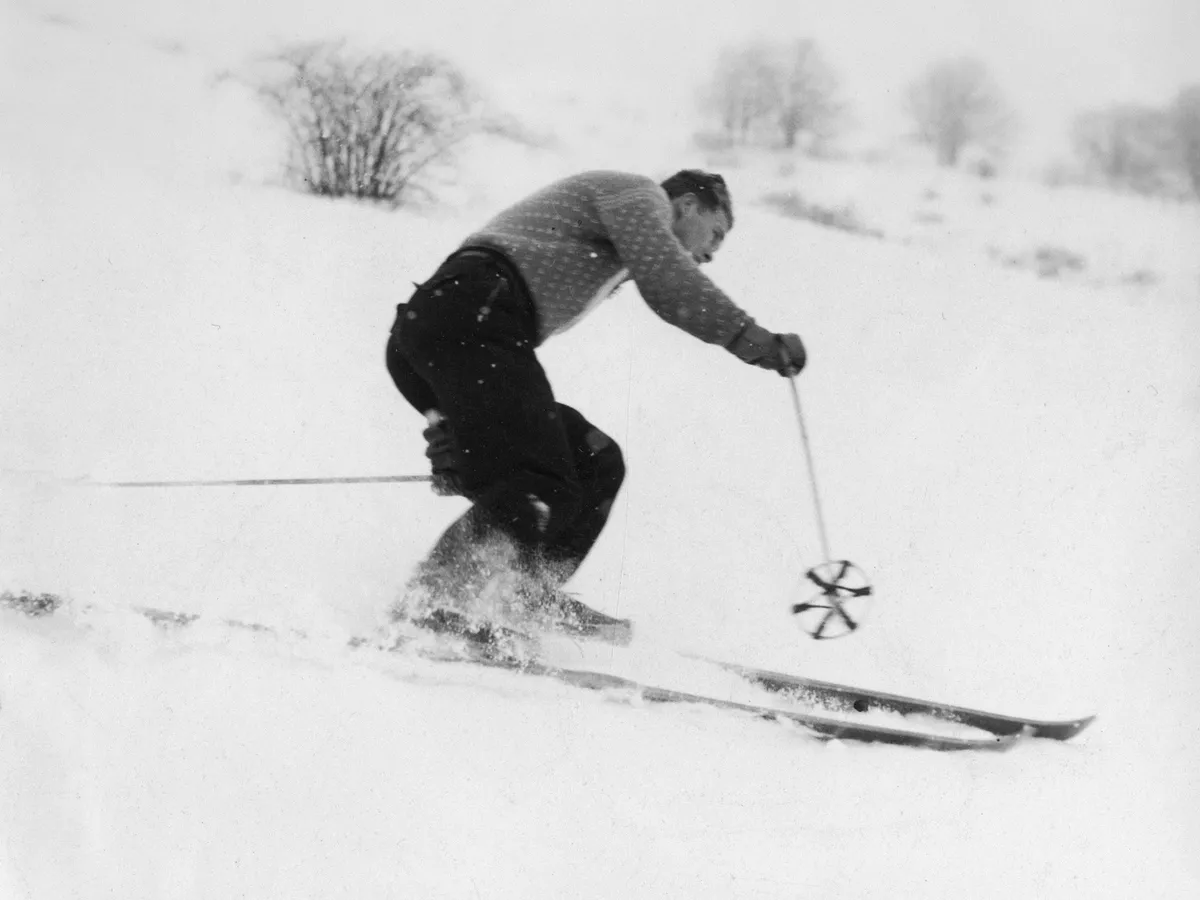
Skiing is thousands of years old, but there wasn’t a single moment when someone invented the sport we know today. Skis were tools for traveling and hunting in snowy country long before people raced downhill or bought lift tickets. The interesting part is how that practical tool became a way to spend a winter weekend.
It started as a way to get around
Before it was a sport, skiing was a way to cross snow-covered country. One unusually personal piece of evidence comes from Norway’s Digervarden ice patch. Archaeologists found a roughly 1,300-year-old ski there in 2014, then recovered its partner in 2021. Both retained parts of their bindings. A repaired foothold on the second ski shows that this was equipment someone had used and maintained.
The discovery also shows why an invention date is so difficult to pin down. A surviving ski tells us that people were skiing by that time; it does not tell us when the practice began. The Digervarden team cannot say whether the owner was hunting, traveling, or doing both. That uncertainty is part of the story, not a reason to invent a first skier.
The people who did it first
The early skiers were not athletes, they were hunters and travelers. The ancestors of the Sami people, across the far north of Norway, Sweden, Finland, and Russia, skied for hunting and transport for thousands of years, moving over the snow after reindeer with skis and sleds. Skiing was infrastructure, and it stayed that way for a very long time.
How it turned into a sport
The shift from tool to sport ran through one Norwegian in particular. Sondre Norheim, born in 1825 in Morgedal in the Telemark region, is the name to know. He rebuilt the gear so it could be steered: heel bindings that held the boot to the ski, and skis cut narrower at the waist than at the tip and tail, the side-cut that lets a ski turn instead of just point downhill. He won an early national skiing competition in Christiania, now Oslo, in 1868, and the turn he made famous still carries the name of his region. Every time someone drops a Telemark turn on the hill, that is Morgedal, more than 150 years later. Norheim emigrated to the US in 1884, which is a fair segue, because skiing was already crossing the Atlantic.
How it got to America
It came over in the 1850s with Norwegian immigrants, and the first great American skier had a mail route. Snowshoe Thompson, born in Telemark and raised in the Midwest, turned up in California in 1852 for the Gold Rush and ended up carrying the mail on skis. For about twenty years he ran roughly 90 miles each way over the Sierra Nevada, from Placerville, California to Genoa, Nevada, on homemade oak skis close to ten feet long, through storms that stopped everyone else. He was never paid by the federal government for it, despite years of carrying the mail.
Meanwhile the gold camps had found racing. Miners in the Sierra towns, places with names like Poker Flat, La Porte, and Johnsville, strapped on “longboards” and pointed them straight down the hill, no turning, just a greased board and nerve. By 1860 they had clubs with elected officers and written rules, and the fastest of them were clocked at speeds reported near 90 miles an hour, chasing cash prizes that ran as high as a thousand dollars in silver. This was competitive downhill racing in America half a century before the first chairlift, and almost nobody remembers it happened.
Then the machines showed up
The piece that turned skiing into the industry you buy a ticket to arrived in January 1934, on Clinton Gilbert’s farm outside Woodstock, Vermont. It was a loop of rope, about 1,800 feet of it, dragged around by the engine of a Model T up on blocks, hauling skiers up a 900-foot slope for a few dollars. It was the first ski tow in the United States, per the Vermont Historical Society, and it changed the whole thing, because for the first time you could ski down without the misery of climbing back up. Every high-speed six-pack and gondola on the mountain today is a descendant of that Model T and that rope.
The long view
Skiing has no single documented birthday. Its long history combines practical travel, changing equipment, organized competition, and eventually mechanized uphill transport. Those are different milestones. The lifts you ride today explain the modern resort day, but the repaired wooden skis from Digervarden make an older connection: someone needed a pair of skis that worked, and kept them going.