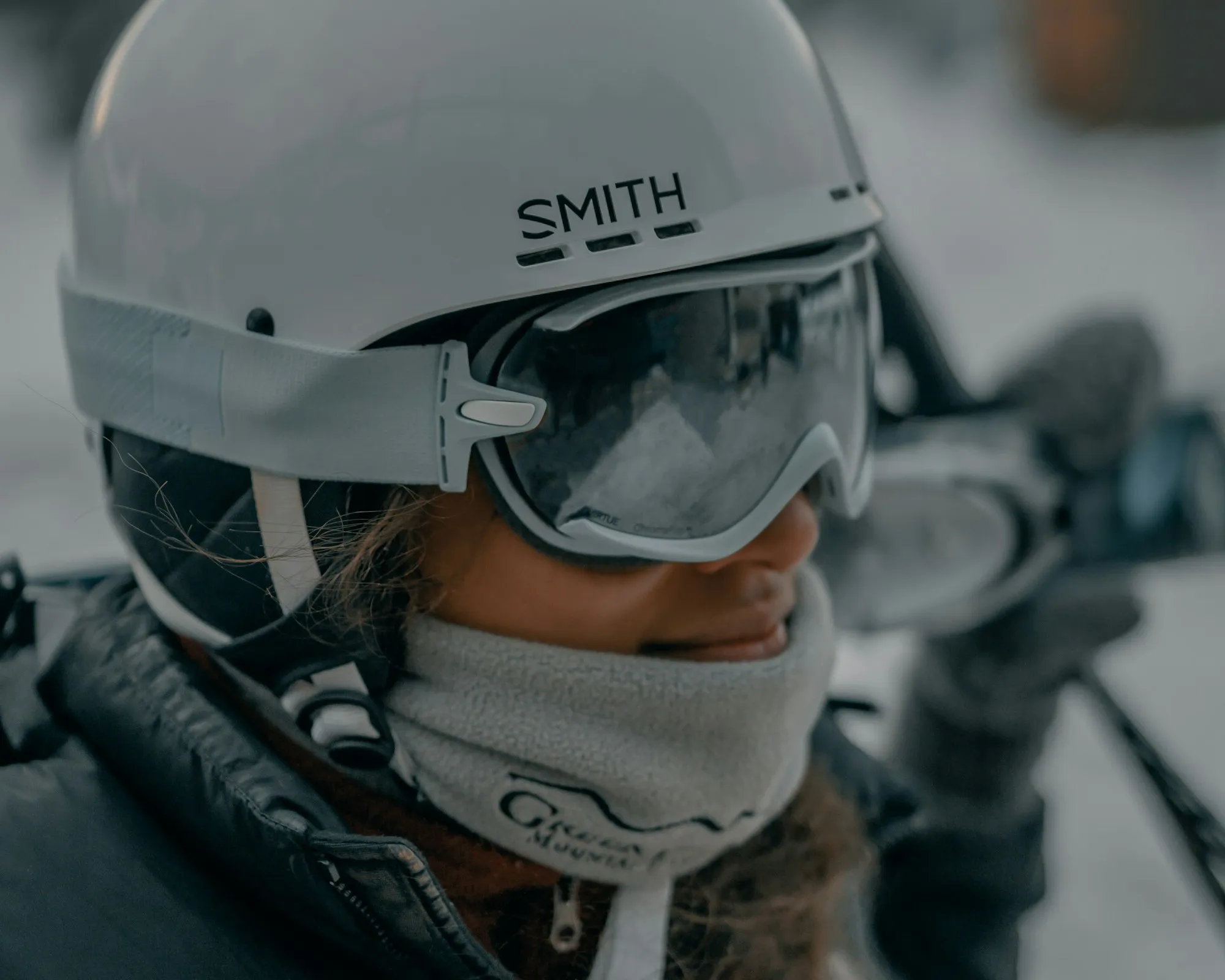
A goggle that does not fit is a goggle that fogs, gaps, and leaves pressure marks, and for skiers with smaller faces that is the usual problem with grabbing whatever is on the wall. The fix is a frame built for a smaller face: a narrower nose bridge, a shorter vertical height, and a shape that seals without a gap at the cheeks or forehead. Some of those are women’s-specific designs; others are unisex goggles that happen to come in a small fit. This guide covers both, and is clear about which is which, because the label matters less than whether the frame fits your face.
Beyond fit, the choices are about lenses: how dark or bright they are, whether they swap easily, and whether they clear in flat light. The six picks below sort by the job you need a goggle to do, from an everyday all-rounder to a dedicated storm-light setup, with verified lens tints and prices throughout.
How these ski goggles were chosen
Selection prioritized fit for smaller faces, then lens performance and value. Each pick is a current model, and the specifications, lens tints, VLT percentages, and US prices were checked against each brand’s product page and major retailers in June 2026. Lens VLT is the most error-prone spec in this category because it changes with every tint, so each figure here is paired with the named lens it belongs to. Prices move, so treat them as a snapshot.
This guide is spec-based, not field-tested. Recommendations come from published optics, fit dimensions, and lens systems matched to a use case. Where a pick is a unisex goggle in a small fit rather than a women’s-specific design, it says so.
The six women’s ski goggles at a glance
| Goggle | Award | Fit | Lens and swap | Included tint (VLT) | US price |
|---|---|---|---|---|---|
| Anon WM3 | Best Overall | Women’s | Cylindrical, Magna-Tech magnetic | Variable Violet 34% + bonus Cloudy Pink 53% | ~$275 |
| Giro Millie | Best Value | Women’s | Toric, single lens | VIVID Copper 21% (toric) | ~$109 |
| Smith Squad S | Best for Small Faces | Unisex small fit | Cylindrical, manual swap | ChromaPop bright + low-light bonus | ~$129 |
| Oakley Flight Tracker S | Best OTG | Unisex small fit | Toric, Ridgelock | Prizm Sapphire 13% | ~$146 |
| Anon M6S | Best for Bluebird Days | Unisex small/med | Cylindrical, Magna-Tech magnetic | Sunny Onyx 6% + bonus Variable Violet 34% | ~$295 |
| Giro Contour RS | Best for Storm and Flat Light | Reduced-size | Toric, magnetic Snap | Vivid Infrared low-light + darker main | ~$310 |
Prices and lens tints verified June 2026. VLT percentages belong to the specific named tints; other colorways of the same goggle carry different VLT numbers.
Anon WM3
Best Overall
The WM3 is Anon’s flagship women’s goggle, and it earns the all-round pick by getting fit, optics, and convenience right together. It is a genuine women’s frame, it uses Anon’s Magna-Tech magnetic lens system for fast swaps, and it ships with two PERCEIVE lenses (a Variable Violet at 34% VLT for mixed light and a bonus Cloudy Pink at 53% for flat light), so you are covered from sun to storm out of the box. It also integrates with Anon’s MFI magnetic facemask and works over glasses. At around $275 it is not cheap, but it is the goggle here with the fewest compromises for a smaller face. Anon’s newer M6 line is increasingly the small and medium-fit option in the range; the WM3 remains a strong all-rounder where available.
Strengths
- Genuine women’s fit with strong magnetic lens swap
- Two lenses cover sun and flat light out of the box
- Integrates with the MFI facemask, works OTG
Tradeoffs
- Premium price
- Cylindrical lens rather than spherical, a look some skiers prefer
- Magnetic system is convenient but adds cost
- Lens shape
- Cylindrical
- VLT
- Variable Violet 34% + Cloudy Pink 53%
- Frame fit
- Women’s
- Lens swap
- Magna-Tech magnetic
- Price
- ~$275
Best for the skier who wants one women’s-fit goggle that does everything. Skip it if your budget is tighter or you rarely swap lenses.
Giro Millie
Best Value
The Millie is the value standout because it puts genuine women’s fit and ZEISS VIVID optics at around $109 on sale (about $145 at MSRP), well under the premium goggles here. It is a true women’s-specific frame with a toric lens (a flatter, more natural-looking curve than a basic cylindrical lens) carrying Giro’s VIVID contrast-enhancing technology, and in the toric VIVID Copper tint it runs about 21% VLT, a versatile mixed-light setting. It is also OTG-friendly for glasses wearers. It ships with a single lens rather than a two-lens kit, so you choose the tint for your usual conditions, and there is no fast magnetic swap, but for a skier who wants a well-fitting, optically strong goggle without paying flagship prices, nothing else here competes on value. For a rock-bottom budget, a generic option like the OutdoorMaster sits near $30, but the optics and fit are a clear step down.
Strengths
- Genuine women’s fit and ZEISS VIVID optics near $100
- Toric lens for natural, distortion-low vision
- OTG compatible
Tradeoffs
- Single lens, no bonus storm lens included
- No fast magnetic lens-swap system
- Fewer flagship features than the premium picks
- Lens shape
- Toric (ZEISS VIVID)
- VLT
- VIVID Copper 21% (toric)
- Frame fit
- Women’s
- Lens swap
- Single lens, no quick-swap
- Price
- ~$109 sale / $145 MSRP
Best for strong optics and women’s fit on a sensible budget. Skip it if you need a two-lens kit or fast lens changes.
Smith Squad S
Best for Small Faces
When the priority is a frame that fits a small face without overpaying, the Squad S is the pick. It is the small-fit version of Smith’s popular Squad, a dedicated smaller frame rather than a shrunk-down afterthought, and it carries Smith’s ChromaPop contrast optics. The lens is cylindrical and changes manually with slide tabs rather than magnets, which is more fiddly but keeps the price near $129, and it ships with a bonus low-light lens (a yellow tint on the standard Squad S, or a clear lens on the low-bridge-fit version) for night skiing or whiteout. It is unisex rather than women’s-specific, but the small frame fits a lot of smaller faces well, which is exactly what this award is about.
Strengths
- Dedicated small frame that fits smaller faces well
- ChromaPop optics at a mid price
- Ships with a bonus low-light lens
Tradeoffs
- Manual slide-tab lens swap, not magnetic
- Cylindrical lens rather than spherical or toric
- Unisex, not a women’s-specific design
- Lens shape
- Cylindrical (ChromaPop)
- VLT
- ChromaPop bright + low-light bonus
- Frame fit
- Unisex small
- Lens swap
- Manual slide tabs
- Price
- ~$129
Best for a well-fitting small frame at a fair price. Skip it if you want magnetic lens changes or a women’s-specific frame.
Oakley Flight Tracker S
Best OTG
For skiers who wear glasses, the Flight Tracker S, around $146, is the standout, and the best small-fit OTG option in this set. It is the small-fit version of Oakley’s Flight Tracker, with a full-rim, low-profile toric lens for a wide field of view and a design that accommodates eyeglasses comfortably under the goggle. Lenses swap with Oakley’s Ridgelock system, which seats the lens along the bottom edge securely, and the included Prizm Snow lens (the Sapphire tint runs about 13% VLT) is a strong bright-to-mixed-light option with Oakley’s contrast tuning. It comes with a single lens, so plan to buy a low-light Prizm separately if you ski a lot of storms.
Strengths
- Comfortable over glasses
- Wide, low-distortion toric field of view
- Prizm contrast optics, secure Ridgelock swap
Tradeoffs
- Ships with one lens; a second is an added cost
- Small fit is unisex, not women’s-specific
- Ridgelock swap is slower than a magnetic system
- Lens shape
- Toric, full-rim low-profile
- VLT
- Prizm Sapphire 13%
- Frame fit
- Unisex small, OTG
- Lens swap
- Ridgelock
- Price
- ~$146
Best for glasses wearers who want a small fit. Skip it if you do not wear glasses and want a two-lens kit.
Anon M6S
Best for Bluebird Days
Bright, sunny, bluebird days call for a dark, low-VLT lens so you are not squinting through the glare off the snow, and the M6S in a Sunny Onyx colorway ships exactly that. It is Anon’s small and medium-fit frame with a cylindrical PERCEIVE lens, Magna-Tech magnetic lens change, and MFI facemask integration, and in the Sunny Onyx build the standard lens is a PERCEIVE Sunny Onyx at 6% VLT, Anon’s darkest tint, made for hard high-alpine sun. It also comes with a bonus Variable Violet lens around 34% VLT for mixed light, so one goggle covers both ends, though its sweet spot, and the reason it takes the bluebird award, is bright sun. At around $295 it is a premium small-fit option, and it is unisex rather than women’s-specific, so check the fit. It replaces the discontinued Deringer in Anon’s range.
Strengths
- Dark Sunny Onyx 6% lens ideal for bright bluebird days
- Magna-Tech magnetic swap and MFI facemask
- Small and medium PERCEIVE fit, bonus low-light lens included
Tradeoffs
- Cylindrical lens rather than spherical
- Unisex small and medium fit, not women’s-specific
- The 6% lens ships standard only on Sunny Onyx colorways
- Lens shape
- Cylindrical (PERCEIVE)
- VLT
- Sunny Onyx 6% + Variable Violet 34%
- Frame fit
- Unisex small/medium
- Lens swap
- Magna-Tech magnetic + MFI
- Price
- ~$295
Best for sunny, high-glare days in a small-fit frame. Skip it if you mostly ski storms and flat light, or specifically want a women’s-branded frame.
Giro Contour RS
Best for Storm and Flat Light
Storms, heavy snow, and flat light are where most goggles struggle and where a bright, high-VLT lens earns its keep, and the Contour RS, around $310, is built around exactly that. It pairs a toric ZEISS VIVID lens with Giro’s magnetic Snap quick-change system and ships with a bonus Vivid Infrared lens for low light, a true flat-light tint that pulls contrast out of a featureless gray day, plus a darker main lens for sun. On fit, the “RS” stands for Reduced Size: it is built for smaller-than-average faces, so it belongs here as a genuine small-fit option, just gender-neutral rather than women’s-branded. For the skier who chases storm days and wants the best flat-light setup here, the lens system is worth it.
Strengths
- Excellent bright Vivid Infrared lens for flat light
- Fast magnetic Snap lens changes
- Two ZEISS VIVID lenses included
Tradeoffs
- Gender-neutral rather than women’s-branded
- The most expensive pick here
- Even reduced-size may feel large on the smallest faces
- Lens shape
- Toric (ZEISS VIVID)
- VLT
- Vivid Infrared low-light + darker main
- Frame fit
- Reduced-size (small-to-medium)
- Lens swap
- Magnetic Snap
- Price
- ~$310
Best for storm and flat-light days when contrast matters most. Skip it if you specifically want a women’s-branded frame, or if even reduced-size goggles feel too large.
How to choose: fit and lenses
Fit and the nose bridge
Fit is the whole game with a smaller face. The goggle should sit flush against your forehead and cheeks with no gaps, and the nose bridge is where smaller faces most often get it wrong, because a too-wide bridge leaves a cold gap and lets light in. Genuine women’s-fit and small-fit frames address this with a narrower bridge and a shorter vertical height. Try the goggle with your helmet on if you can, since the helmet and goggle have to meet without a gap across the forehead (the dreaded gaper gap).
Small fit and low-bridge fit are not the same. Small fit usually means a smaller frame height and width. Low-bridge fit changes the nose and cheek foam geometry for faces where standard goggles gap at the nose or sit on the cheeks. If your goggles regularly leak air around the nose, look for a low-bridge version specifically, not just a smaller frame.
Lens VLT, explained
VLT, visible light transmission, is the percentage of light a lens lets through, and matching it to conditions matters more than any other lens spec. Low VLT, roughly 5 to 20 percent, means a dark lens for bright, sunny, bluebird days. High VLT, 40 percent and up, means a bright lens for storms, snow, fog, and flat light. Mid-range tints around 20 to 40 percent are the variable-condition all-rounders. If you only own one lens, a mid-range tint is the safest single choice; a two-lens setup lets you cover both ends of the light.
Magnetic versus traditional lens swaps
How a goggle changes lenses affects how often you will do it. Magnetic systems, like Anon’s Magna-Tech and Giro’s Snap, swap in seconds and are far easier with cold hands, usually with a latch or clip to keep the lens from popping off in a fall. Traditional systems, like Smith’s slide tabs or Oakley’s Ridgelock, cost less and hold securely once seated, but they are slower and fussier in the cold. If you swap lenses with the weather, pay for magnetic; if you set one lens and forget it, you do not need to.
OTG and anti-fog
If you wear glasses, look for OTG (over-the-glasses) goggles, which have channels in the foam for eyeglass arms; the Flight Tracker S, WM3, and Millie all work this way. Whatever you choose, fogging comes down to airflow and moisture, so look for good venting and an anti-fog lens treatment, avoid wiping the inside of the lens (it removes the coating), and do not tuck a neck gaiter up over the bottom vents, which is the most common cause of a fogged goggle.
Frequently asked questions
What does VLT mean on ski goggles?
VLT stands for visible light transmission, the percentage of light a lens lets through. A low number, around 5 to 20 percent, is a dark lens for bright sun and bluebird days. A high number, 40 percent and up, is a bright lens for storms, snow, and flat light, when you need to gather as much light as possible. Mid-range lenses around 20 to 40 percent cover variable conditions. Many goggles ship with two lenses so you can swap for the day.
Are women’s ski goggles different, or is it just marketing?
Both exist. Genuine women’s-fit goggles, like the Anon WM3 and Giro Millie, use smaller frames, narrower nose bridges, and shapes built for smaller faces, which is a real fit difference. Other goggles are unisex but come in a small or reduced size that suits many women, such as the Smith Squad S, Oakley Flight Tracker S, Anon M6S, and Giro Contour RS. What matters is fit, not the label, so look for a frame sized to your face rather than the word women’s alone.
Can I wear ski goggles over my glasses?
Yes, with OTG (over-the-glasses) goggles, which have channels in the foam to fit eyeglass arms. Most goggles here, including the Oakley Flight Tracker S, Anon WM3, and Giro Millie, work as OTG. For the best result, choose smaller eyeglass frames, make sure the goggle foam seals around them without gaps, and check that your glasses do not press hard enough to fog. Contacts under standard goggles are the alternative if OTG fit is fussy.
What lens VLT should I pick for my conditions?
Match the lens to the light. For bright, sunny, bluebird days, choose a low-VLT lens around 5 to 20 percent so you are not squinting. For storms, heavy snow, fog, and flat light, choose a high-VLT lens, often 40 percent or more, to see contrast and terrain. If you only buy one lens, a mid-range tint around 20 to 30 percent is the best all-rounder, but a two-lens system lets you cover both ends.
How do magnetic lens-change systems compare to traditional swaps?
Magnetic systems like Anon’s Magna-Tech and Giro’s Snap let you change lenses in seconds with magnets, usually with a clip or latch to keep the lens secure, which is faster and easier with cold hands. Traditional systems, like Smith’s slide tabs or Oakley’s Ridgelock, are more fiddly but tend to cost less and hold the lens just as securely once in. If you swap lenses often, magnetic is worth paying for; if you rarely change, it is not essential.
The short version
For one women’s-fit goggle that handles everything, the Anon WM3 is the all-rounder, with a strong magnetic swap and two lenses in the box. For genuine women’s fit and ZEISS optics on a budget, the Giro Millie near $100 is the value pick.
From there, match it to your face and your light: the Smith Squad S for a well-fitting small frame, the Oakley Flight Tracker S for glasses wearers, the Anon M6S for bright bluebird days, and the Giro Contour RS for storm and flat light. Fit comes first, so try frames on with your helmet where you can. For the rest of the kit, the ski gear guides cover what else goes in the bag, and caring for ski gloves keeps your hands sorted.
Lens tints, VLT figures, and prices in this guide were verified against current brand information and major US retailers in June 2026. Lineups and prices change; confirm the current lens and VLT on the brand’s product page before buying. If you find an error in this guide, please email corrections@slopehound.com.