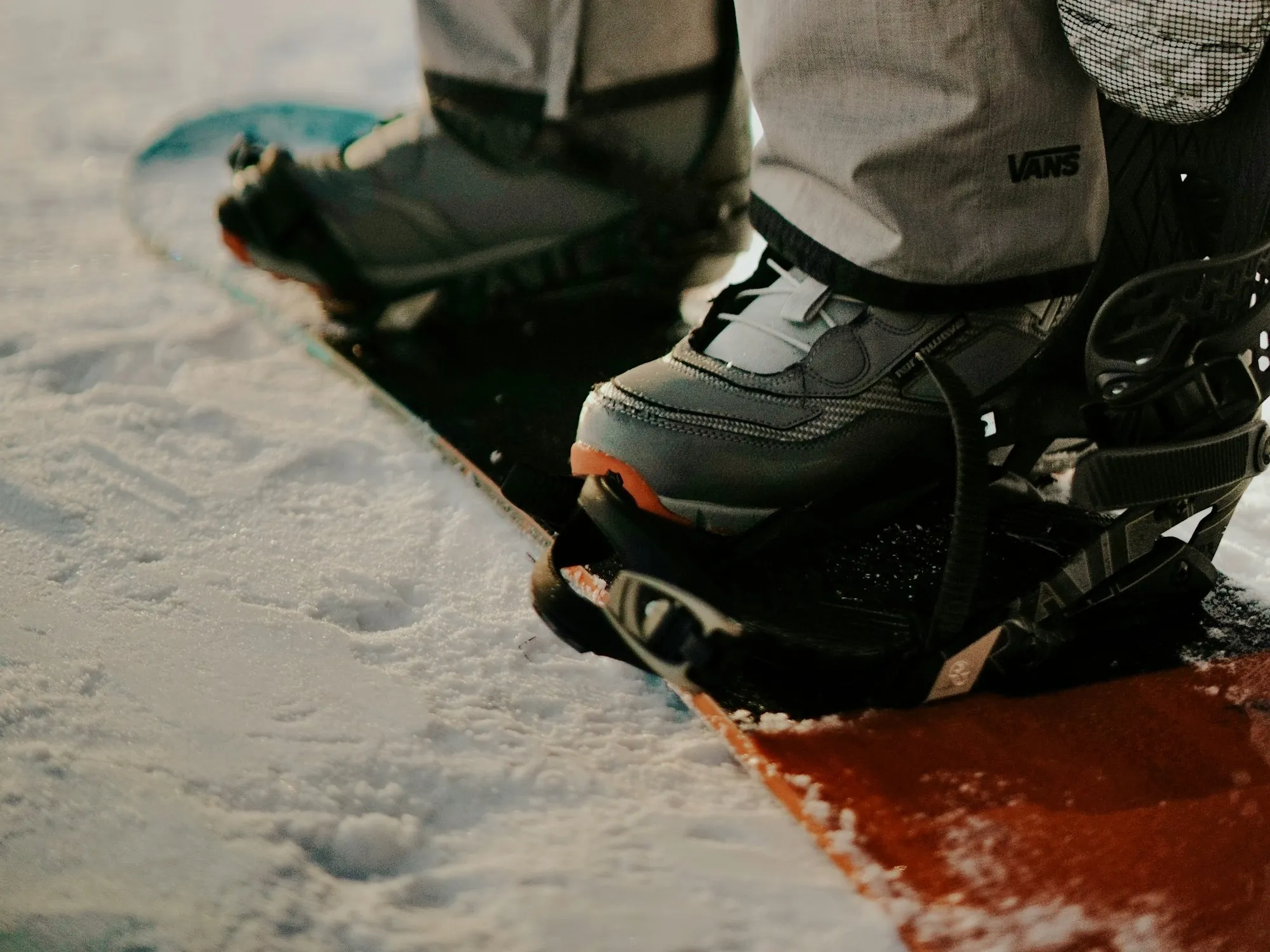
Boots are the most important and most personal piece of snowboard gear, because they are the only part that has to fit your actual foot. A great board with bad boots rides badly; mediocre boots that fit perfectly will still let you ride well. Two variables drive the choice: flex rating, which is how stiff or soft the boot is and is the single biggest factor to match to your riding, and the lacing system, which is how you tighten them. Everything else, including the liner and footbed, is in service of fit.
The picks below are organized primarily by flex, from soft park boots through medium all-mountain boots to stiff freeride boots, plus the best value and the best heat-moldable liner. But read the fit section first and treat it as more important than any single pick: the right boot is the one that fits your foot, and no roundup can size your foot for you.
Fit beats everything here. Flex and lacing narrow the field, but boots must be tried on with your riding socks before you buy. Use the awards to build a shortlist, then fit it in person.
How these boots were chosen
Selection covered the flex spectrum and the main lacing systems, across the brands that make well-regarded snowboard boots, with a clear use case for each. Each pick is a current model, and flex rating, lacing system, liner type, and US price were verified against each brand’s product page and major retailers in June 2026. Models the older guides listed as discontinued or BOA-only-now were updated to current configurations. Prices and exact specs change, so treat the figures as a snapshot.
A note on flex numbers: brands rate flex on their own 1-to-10 scales, and a 7 from one brand is not identical to a 7 from another. Use the ratings as a guide within this guide, not as a precise cross-brand standard. This guide is spec-based, not field-tested, and fit is personal, so use it to build a shortlist to try on.
The six boots at a glance
| Boot | Award | Flex (1-10) | Lacing | Best for | US price |
|---|---|---|---|---|---|
| K2 Maysis | Best Overall | 7, medium-stiff | BOA shell + BOA Conda heel harness | All-mountain control | $379.95 MSRP |
| Vans Hi-Standard OG | Best Traditional-Lace Value | 4-5, medium | Traditional lace | Beginner, park, all-mountain | $199.95 MSRP / sale ~$140 |
| Burton Moto BOA | Best Soft / Park | 3, soft | Single-zone BOA | Park, freestyle, entry | $279.95 MSRP |
| Salomon Dialogue Dual BOA | Best Medium All-Mountain/Freestyle | Medium | Dual BOA | Versatile all-mountain | $429.95 MSRP |
| K2 Thraxis | Best Stiff / Freeride | 10, stiff | Triple BOA | Freeride, speed, steeps | $539.95 MSRP |
| ThirtyTwo TM-2 Double BOA | Best Customizable Fit | 7.5, medium-stiff | Double BOA | Custom fit, all-mountain | $479.99 MSRP / sale ~$336 |
Prices verified June 2026 and rounded. Flex numbers are brand-stated and not cross-comparable.
K2 Maysis
Best Overall
The K2 Maysis is a longtime favorite and the best all-around boot here because it nails the things that matter for most riders. Its medium-stiff flex (around 7) gives confident all-mountain control without being punishing, and its standout feature is the lacing: a single external H4 Coiler BOA closes the whole shell, while K2’s BOA-powered Conda, a separate internal harness, pulls the heel into the pocket and kills heel lift, the most common boot complaint. It comes with a heat-moldable Intuition liner for a custom fit, and a Maysis Wide is available at the same MSRP for wider feet. At $379.95 MSRP it is not cheap, but the heel-hold system and versatile flex make it the boot that suits the widest range of riders, which is exactly what the overall pick should be.
Strengths
- External BOA plus BOA Conda harness locks the heel down
- Versatile medium-stiff flex for all-mountain
- Heat-moldable liner included; Maysis Wide available
Tradeoffs
- Premium price
- Too stiff for pure park playfulness
- BOA repair on the hill is harder than laces
- Flex
- 7 of 10, medium-stiff
- Lacing
- BOA shell + BOA Conda heel harness
- Fit profile
- All-mountain (Maysis Wide available)
- Liner
- Intuition heat-moldable
- Price
- $379.95 MSRP
Best as the do-everything all-mountain boot. Skip it if you want a soft park boot or the cheapest option.
Vans Hi-Standard OG
Best Traditional-Lace Value
The Vans Hi-Standard OG is a perennial value champion and the smart first boot. It is a forgiving, medium-flex (around 4 to 5) traditional-lace boot at $199.95 MSRP, often discounted to around $140 to $160, and the simplicity is a feature: traditional laces are infinitely adjustable, trivially repaired with a spare lace, and let you fine-tune tension zone by zone. It also runs a heat-moldable V1 UltraCush HD liner, unusual at this price, so the fit dials in rather than just packing out. The forgiving flex suits beginners, park riders, and easygoing all-mountain cruising. You give up the speed and even tension of BOA and the support of a stiff boot, but for a new rider, a park rider, or anyone on a budget, the Hi-Standard delivers a good boot for the least money.
Strengths
- Strong value: $199.95 MSRP, often discounted
- Heat-moldable V1 UltraCush HD liner, rare at this price
- Laces are infinitely adjustable and easily repaired
Tradeoffs
- Laces are slower and harder with cold hands
- Medium flex still lacks a stiff boot’s support at speed
- Fewer heel-hold features than premium boots
- Flex
- 4 to 5 of 10, medium
- Lacing
- Traditional lace
- Fit profile
- Beginner, park, all-mountain
- Liner
- V1 UltraCush HD heat-moldable
- Price
- $199.95 MSRP (~$140 sale)
Best for beginners, park riders, and budgets. Skip it if you ride fast, aggressive, or steep terrain.
Burton Moto BOA
Best Soft Flex (Park)
The Burton Moto BOA pairs a soft, forgiving flex with the convenience of BOA, which makes it a great entry and park boot for riders who want easy tightening. Its soft flex (around 3) is playful and tolerant of the sloppy technique that comes with learning and with park riding, and the single-zone BOA dial means you can cinch it evenly with gloves on in seconds and adjust it on the lift. It comes with Burton’s heat-moldable Imprint 1+ liner, in regular and wide widths. Burton also sells a non-BOA Moto with Speed Zone lacing, currently around $249.95, for riders who prefer a traditional speed-lace closure. At $279.95 MSRP the BOA version is the easy-living soft boot: forgiving where you want forgiveness, quick where you want quick, and a comfortable step up from the cheapest options.
Strengths
- Soft, forgiving flex for park and beginners
- BOA convenience: fast, even, glove-friendly
- Comfortable, easy entry
Tradeoffs
- Soft flex lacks control at speed
- Single-zone BOA gives less zone control than dual
- Costs more than the laced Speed Zone Moto
- Flex
- 3 of 10, soft
- Lacing
- Single-zone BOA
- Fit profile
- Park, entry (regular + wide)
- Liner
- Imprint 1+ heat-moldable
- Price
- $279.95 MSRP
Best for park and progressing riders who want soft flex with BOA ease. Skip it if you ride aggressively or want zone-by-zone lace control.
Salomon Dialogue Dual BOA
Best Medium All-Mountain/Freestyle
The Salomon Dialogue in its Dual BOA configuration is the versatile medium-flex all-mountain pick, the boot for riders who do a bit of everything. Its medium flex is the sweet spot that handles groomers, trees, a little park, and the occasional steep run without committing to soft or stiff, and the dual-zone BOA lets you tighten the lower and upper independently for a tuned fit. It runs Salomon’s heat-moldable Response liner on a lighter FTR construction. Salomon has a strong boot pedigree, and the Dialogue is its well-rounded workhorse, with a Dialogue Dual BOA Wide variant for wider feet. At $429.95 MSRP it costs more than entry boots, but the medium flex and dual-zone tuning make it the natural choice for the rider who wants one boot for the whole mountain.
Strengths
- Versatile medium flex for the whole mountain
- Dual-zone BOA for tuned, independent tightening
- Heat-moldable Response liner; Wide variant available
Tradeoffs
- Premium price
- Not specialized for park or freeride
- BOA repair on the hill is harder than laces
- Flex
- Medium
- Lacing
- Dual-zone BOA
- Fit profile
- All-mountain (Wide available)
- Liner
- Response heat-moldable (FTR)
- Price
- $429.95 MSRP
Best for all-mountain riders who want one versatile boot. Skip it if you want a specialized soft park boot or a stiff freeride boot.
K2 Thraxis
Best Stiff Flex (Freeride)
The K2 Thraxis is K2’s stiffest and most supportive boot, a high-performance freeride boot for riders who charge. Its 10-of-10 flex delivers the precise, immediate response you want at speed and in steep, demanding terrain, and its triple-BOA system (two exterior dials plus a BOA-powered Conda inner harness) gives micro-adjustable tension plus a locked-down heel. It comes with a heat-moldable Intuition liner for a dialed fit, which matters most in a stiff boot where pressure points are punishing. At $539.95 MSRP it is the priciest boot here, and the stiff flex is overkill (and uncomfortable) for casual or park riding, but for aggressive freeriders and anyone chasing big lines and high speed, the responsiveness is the point.
Strengths
- Stiff, immediate response for speed and steeps
- Triple BOA (2 exterior + Conda), locked-down heel
- Heat-moldable liner included
Tradeoffs
- The most expensive boot here
- Too stiff for casual, beginner, or park riding
- Three dials are more to manage
- Flex
- 10 of 10, stiff (K2’s stiffest)
- Lacing
- Triple BOA (2 exterior + Conda)
- Fit profile
- Freeride
- Liner
- Intuition heat-moldable
- Price
- ~$540
Best for aggressive freeriders and fast all-mountain riders. Skip it if you ride park, are learning, or want a forgiving boot.
ThirtyTwo TM-2 Double BOA
Best Customizable Fit
The ThirtyTwo TM-2 is a long-running team favorite, and the standout here is its fit system: a Performance Fit liner of dual-density heat-moldable Intuition foam with a heel-hold kit, which molds precisely to your foot, the single best thing you can do to cut heel lift and pressure points. Its medium-stiff flex (7.5 of 10) is versatile across the mountain, and the Double BOA gives quick, even, two-zone tightening. ThirtyTwo built its reputation on boots, and the TM-2 is the line that made it, with a TM-2 Wide Double BOA for wider feet. At $479.99 MSRP, currently on sale around $335.99, it offers a premium customizable fit, which makes it the pick for riders with hard-to-fit feet or anyone who has fought heel lift in standard boots.
Strengths
- Premium Performance Fit, dual-density heat-moldable liner
- Versatile medium-stiff 7.5 flex
- Double BOA for quick, even tightening; Wide available
Tradeoffs
- Best fit needs a shop heat-mold
- Medium flex is not specialized for park or freeride
- BOA repair on the hill is harder than laces
- Flex
- 7.5 of 10, medium-stiff
- Lacing
- Double BOA (Wide available)
- Fit profile
- All-mountain
- Liner
- Performance Fit, heat-moldable
- Price
- $479.99 MSRP (~$336 sale)
Best for riders with hard-to-fit feet or chronic heel lift. Skip it if a standard liner already fits you well.
How to choose snowboard boots
Fit comes first
No award outranks fit. A snowboard boot should hold your heel down firmly, with your toes just brushing the end when you stand straight and pulling back slightly when you flex into your stance. Boots pack out as the liner compresses with use, so a boot that feels perfect in the shop will loosen after a few days; start snug with your toes touching. Heel lift is the enemy, because it destroys control and causes blisters. Always try boots on with the socks you will ride in, and walk and flex in them in the shop before deciding. Most picks here are men’s models; women and lower-volume-foot riders should look for the equivalent women’s model or a brand-specific low-volume fit where available, since most of these brands publish women’s or lower-volume versions of these boots.
Flex rating
Flex is the biggest variable to match to your riding. Soft boots (around 1 to 4) are forgiving and playful, ideal for beginners and park riders who want easy tweaking and tolerance for imperfect technique. Stiff boots (around 7 to 10) give precise, responsive control at speed and in steep terrain, which freeride and aggressive all-mountain riders want. Medium flex (around 5 to 6) is the versatile middle that suits most all-mountain riders. Remember that brands rate flex on their own scales, so use the numbers as a guide rather than an exact cross-brand standard.
Lacing system
There is no single best lacing system, only tradeoffs. BOA uses a dial and lace system, textile or metal depending on the boot, for fast, micro-adjustable tightening that is easy to adjust on the lift; BOA parts are replaceable and backed by BOA’s support, but a broken BOA lace or dial is still harder to improvise on the hill than a traditional lace. Traditional laces are infinitely adjustable zone by zone and trivially repairable with a spare lace, but slower and harder with cold hands. Speed-lace systems sit between the two, and many boots use a hybrid, such as BOA for the outer plus a separate inner-liner harness (like K2’s Conda) to lock the heel. Choose by how much you value speed and even tension versus repairability and zone control.
Step On is a system, not just a boot. Burton Step On boots clip into Step On bindings and only work with them. Every boot in this guide is standard strap-binding compatible. Do not buy a Step On boot unless you are riding Step On bindings.
Liner and the long view
The liner drives comfort and heel hold, and a heat-moldable liner molds to your foot to cut pressure points and lift, which is worth it for hard-to-fit feet. Plan to replace boots more often than your board or bindings: many riders get roughly 50 to 100 days before the liner packs out and the boot loses support. Once you have boots sorted, the next step is getting comfortable on the board, which the guide to how to learn snowboarding walks through.
Building out the rest of the kit? Best snowboard pants, 2026 covers the cuff-over-boot fit these boots sit inside. Best snowboard jackets, 2026 handles the shell layer. Best snowboard goggles, 2026 closes the head-to-toe setup.
Frequently asked questions
What does flex rating mean on a snowboard boot?
Flex rating describes how stiff or soft the boot is, usually on a 1-to-10 scale where 1 is the softest and 10 is the stiffest. Soft boots (around 1 to 4) are forgiving and playful, good for beginners and park riders who want easy tweaking and a tolerance for sloppy technique. Stiff boots (around 7 to 10) give precise, responsive control at speed and in steep terrain, which freeride and aggressive all-mountain riders want. Medium flex (around 5 to 6) is the versatile middle that suits most all-mountain riders. Flex is the single most important boot variable to match to your riding.
Are BOA boots better than traditional laces?
Neither is strictly better; they trade off differently. BOA uses a dial and lace system, textile or metal depending on the boot, for fast, micro-adjustable tightening that is easy to adjust on the lift; BOA parts are replaceable and backed by BOA’s support, but a broken BOA lace or dial is still harder to improvise on the hill than a traditional lace. Traditional laces are infinitely adjustable zone by zone and trivially repairable with a spare lace, but they are slower and harder to cinch with cold hands. Speed-lace (pull-cord) systems sit in between. Many boots now use a hybrid, such as BOA for the outer with a separate inner-liner closure. Choose by how much you value speed and even tension versus repairability and zone control.
How should snowboard boots fit?
Snug, not painful. A snowboard boot should hold your heel down firmly with your toes just brushing the end when you stand straight, then pulling back slightly when you flex into your riding stance. Boots pack out (the liner compresses) with use, so a boot that fits perfectly in the shop will be too loose after a few days; start with your toes touching. Heel lift is the enemy, since it kills control and causes blisters. Always try boots on with your riding socks, and consider a heat-moldable liner for a custom fit.
What is a heat-moldable liner?
It is a boot liner made from foam that softens when heated and then molds to the exact shape of your foot as it cools, giving a custom fit that reduces pressure points and heel lift. Many liners mold gradually just from the heat of riding, but a shop heat-mold (or an at-home oven mold per the maker’s instructions) speeds it up and improves the result. Heat-moldable liners are especially worth it if you have hard-to-fit feet, wide or narrow, or get pressure points and heel lift in standard liners.
How long do snowboard boots last?
Many riders get roughly 50 to 100 full days out of a pair, though it varies with how hard you ride and the boot’s quality. The liner packs out and loses support before the shell wears through, so the boot getting noticeably looser and softer, with more heel lift, is usually the sign it is done even if it looks fine outside. Boots tend to wear out faster than bindings or a board, so budget to replace them more often. Drying them out after every day and not storing them packed away wet extends their life.
The short version
For most riders, the K2 Maysis is the best all-around boot, thanks to its versatile medium-stiff flex and the Conda inner harness that locks your heel down. If money is tight or you are starting out, the Vans Hi-Standard OG is a good value boot at $199.95 MSRP, often discounted.
From there, match it to your flex and your feet: the Burton Moto BOA for soft-flex park ease, the Salomon Dialogue Dual BOA for versatile all-mountain riding, the K2 Thraxis for stiff freeride performance, and the ThirtyTwo TM-2 for a customizable, heat-moldable fit. Whatever you shortlist, try it on with your riding socks first, then get out and ride with the guide to how to learn snowboarding.
Specifications and prices in this guide were verified against current brand information and major US retailers in June 2026. Models, configurations, flex ratings, and prices change; confirm current details on the brand’s product page before buying. If you find an error in this guide, please email corrections@slopehound.com.